Darrey’s mother was settled in the UK before he was born. If Darrey had been born in the UK, he would have been a British citizen at birth. However, Darrey was a premature baby, and his mother gave birth to him abroad. When she returned to the UK, bringing Darrey with her, he was only five months old.
On their arrival, baby Darrey was granted six months leave to enter.
In September 2003, Darrey’s mother applied for British citizenship, and she was naturalised the following year. Meanwhile, baby Darrey’s leave to enter expired.
Growing up in the UK
Darrey has spent almost all his life in the UK. He has no memories of life anywhere else.
He grew up in London. He believed he was a British citizen just like his mother, stepdad and two younger British born siblings. They all thought so too.
Darrey worked hard and did well at school. He thought about his future and made plans to study construction management or architecture. When he was 17 years Darrey applied to go to university just like his school friends. He was asked to provide a copy of his British passport.
A shocking discovery
Darrey thought he was British and applied for his first British passport. He did it himself. However, instead of issuing him with a passport, the Passport Office asked for more information – and Darrey did not know what to do.
The Passport Office treated his first application as withdrawn and, when he made another application, they refused it. Darrey got a letter in December 2021 telling him that he was not a British citizen.
This was the first time it had ever been suggested that he was not British – and it was quite a shock. Darrey grew up in the UK, surrounded by family members who are all British citizens, knowing home only as the UK.
However, Darrey is a resilient person. The sort of person who gets on with things. He needed a British passport and if the Passport Office would not give him one, he would just have to apply to the Home Office to make him a British citizen and then apply once more for a passport.
So, in 2022, Darrey applied to be naturalised. He again did this himself. By now, he had lived in the UK for 19 continuous years since his mother returned home with him when he was still a baby.
Another shock
But the Home Office refused to naturalise Darrey because he was not settled. In fact, not only did he not have ILR (indefinite leave to remain), he had no permission to be in the UK at all.
When Darrey first contacted PRCBC, he was confused and depressed. His life had been shattered. His friends were moving on with their lives in ways just like he had expected he would. But just as he was looking forward to going to university, the Passport Office and Home Office had ripped up all his expectations about who he even was, let alone what would be his future.
When PRCBC took on Darrey’s case, we applied for all his Home Office and Passport Office records. These records revealed nothing to help us secure British citizenship for Darrey.
How to secure citizenship for Darrey?
Although Darrey was as strongly connected to the UK as it was possible to imagine, the facts remained that he had no permission to be in the UK, he was not born in the UK, and he was now an adult.
In June 2022, section 4L of the British Nationality Act 1981 took effect. It was introduced by the Nationality and Borders Act 2022. It gave a new discretionary power for the Home Office to register an adult as a British citizen – but only if the person “would have been or been able to become” a citizen but for some past legislative unfairness, act or omission of a public authority, or other exceptional circumstances relating to the person.
Without section 4L, there would have been no basis to apply for British citizenship – or at least so it seemed.
PRCBC assisted Darrey to apply to be registered as a British citizen under section 4L. It was clear that he would or should have been registered as a citizen if any application had been made for this – from at least the time his mother made her own naturalisation application (when he was barely one year old). He had no responsibility for why no application had been made.
PRCBC also assisted Darrey to apply for leave to remain – as he needed permission to be in the UK while his citizenship got sorted out. Given his exceptional circumstances, we asked the Home Office to exercise its discretion to grant ILR.
More refusals and off to court
The Home Office refused to register Darrey as a British citizen. It also refused him ILR, though granted him leave to remain on payment of the immigration health charge.
PRCBC assisted Darrey in issuing separate judicial review proceedings against each refusal.
First, Darrey brought proceedings against the refusal of ILR. After the High Court granted permission for that claim to be heard, the Home Office settled with costs. In 2025, the Home Office granted ILR and repaid the immigration health charge that would not have been demanded if the original ILR application had not been refused.
Later, Darrey brought proceedings against the refusal of citizenship. This followed an internal review process. Again, the High Court granted permission for that claim to be heard. Again, the Home Office then settled with costs.1
Another shock – but this time a good one
The reasons for settling the citizenship claim were especially surprising. The Home Office, in preparing for that claim to be heard, had searched their records more thoroughly. They uncovered the naturalisation application that Darrey’s mother had made in 2003 – it showed that on that same application, she had also applied for his registration.
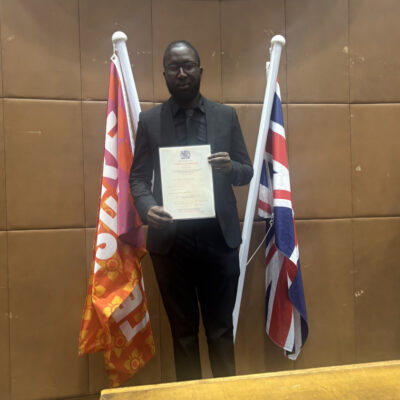
So, 23 years later, the Home Office finally decided and granted an application they had received when Darrey was barely one year old.
Not only has Darrey finally been given the citizenship he would and should have had years ago, the Home Office has repaid the fees for all the interim applications –passports, naturalisation, registration and ILR – that would never have been made if that original registration application had been dealt with 23 years ago.
Of course, we are delighted for Darrey. But that cannot take away any of the distress difficulties and lost opportunities he has suffered – nor that of other young people who grow up in the UK, only to discover they are without its citizenship even though it may be the only place they have ever known.
- Our gratitude to Steve Valdez-Symonds, Admas Habteslasie (Landmark Chambers) and Adrian Berry KC (Garden Chambers) for their legal assistance and support in these judicial review proceedings. ↩︎