Donte is now a British citizen and we are celebrating that. However, Donte is far from alone in growing up in this country alienated by the failure of adults to secure his citizenship in his childhood. Please, therefore, support our vital work – donate if you can and raise awareness of this ongoing injustice.
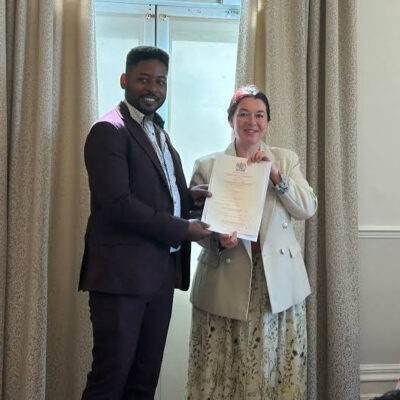
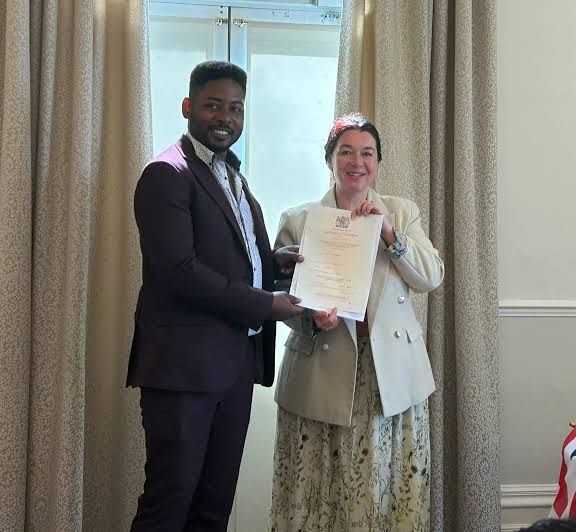
In June 2026, Donte attended his ceremony and finally became a British citizen. We are so very pleased to have achieved this for him.
Donte will be 30 years old later this year. He has lived in the UK ever since a British couple adopted and brought him here at the age of two. They did nothing to secure his right to stay and belong in the country where they had brought him to live.
Social services were first involved when Donte was still a toddler. They were called on several times to intervene during his childhood but never followed through. Even when his adoptive parents made him homeless, social services provided limited assistance but did nothing to address his lack of status in the UK. He was then 16.
When PRCBC first met Donte
When Donte first came to us, he was 28. He had just been refused registration as a British citizen on an application he made by himself. He had no status whatsoever in the UK – and had been without any status for almost all his life here.
Although Donte could and should have been registered as a British citizen in his childhood, this possibility ended when he turned 18.
Donte’s citizenship rights
However, in June 2022, the British Nationality Act 1981 was amended to provide a new discretion for the Home Office to correct a past injustice that had prevented someone becoming a British citizen. This new provision is section 4L of the Act.
Section 4L meant Donte could be registered now by showing he would have become a British citizen in the past but for exceptional circumstances or the failures of social services.
Given the neglect of his adoptive parents throughout his childhood, there was little independent evidence or records other than those of social services and the documentation of such things as Donte’s birth in the USA and his adoption by the British couple that brought him here.
Nonetheless, it was clear that Donte would have been registered as a British citizen had his adoptive parents made an application for that. As a child adopted by British citizens by order of a US court and lawfully brought to the UK for the purposes of that adoption, any application should have been granted.
Similarly, if social services had assisted him to get registered when he was homeless, an application would have been successful. They knew he was without status and they should have been diligent to address his citizenship rights before he turned 18.
There were also strong indications that, when he was even younger, social services ought to have taken Donte into care. If so, a registration application would have led to him becoming a British citizen.
The work PRCBC had to do
On taking on Donte’s citizenship case, we had three major tasks. First, we needed to put together the evidence and representations to support an application for a review of the Home Office refusal to register him. Second, we urgently had to address the complicated circumstances in which he was now living without any status here. And third – as best as we could – we had to support him through the legal processes that lay ahead.
Over the last year, we have made various applications to the Home Office – to obtain a fee waiver to enable him to apply for permission to live in the UK, an application for that permission, an application to permit him to stay in rented accommodation pending the grant of that permission, and the citizenship application that this was always about.
These applications have all been complex and required hours of preparation. However, they were all granted – except for the citizenship application.
The Home Office has adopted a very restrictive interpretation of section 4L. In other cases, we have needed to issue proceedings in the High Court to challenge their refusal to register under this provision.
In Donte’s case, we had to issue two pre-action letters – warning letters, explaining that if the Home Office did not register him then we would bring a challenge and why. The first resulted in the Home Office reconsidering and refusing again. In response to the second, the Home Office reversed their decision.
A citizen at last – but there are others who need help too
Along the way, our work led the Home Office to grant Donte indefinite leave to remain – even without a fee or an application. But even that fell far short of what was needed to put right the injustice he has suffered by exclusion from citizenship of the UK, which has been his home since he was two years old.
Donte is now a British citizen and we are celebrating that. However, Donte is far from alone in growing up in this country alienated by the failure of adults to secure his citizenship in his childhood. Please, therefore, support our vital work – donate if you can and raise awareness of this ongoing injustice.